
Credentials
The Agent Runner reads no secret from environment variables or a .env file. Secrets come in two classes:
a handful of bootstrap secrets the runner needs before any page exists, provided as files, and the
operational secrets agents work with, which Agent Pool administrators manage in Administration → Credentials and
which live encrypted in the runner’s secret store. Everything that is not secret — the Polarion URL, the LLM
gateway URL, PocketBase email, sandbox settings — is plain configuration in agentic.env.
Overview
Section titled “Overview”flowchart LR
subgraph B["<b>Bootstrap secrets</b> — files at /run/secrets, before the runner starts"]
direction TB
F1["<b>secret_key</b><br/><small>encrypts the secret store</small>"]:::ext
F2["<b>admin_token</b><br/><small>runner's Polarion administrator</small>"]:::ext
F3["<b>pocketbase_admin_password</b><br/><small>PocketBase superuser</small>"]:::ext
F4["<b>opensandbox_api_key</b><br/><small>empty file = no sandboxes</small>"]:::ext
end
subgraph O["<b>Operational secrets</b> — Administration → Credentials, no restart"]
direction TB
S1["<b>Model key</b><br/><small>LLM gateway key for every agent</small>"]:::pol
S2["<b>Agent tokens</b><br/><small>one Polarion token per agent</small>"]:::pol
S3["<b>Connected systems</b><br/><small>set when a connection is registered</small>"]:::pol
end
A["<b>Administrator</b><br/><small>pastes a value, once</small>"]:::you --> O
B --> R["<b>Agent Runner</b><br/><small>reads files on start</small>"]:::run
O --> ST["<b>Encrypted store</b><br/><small>AES (Fernet) with secret_key</small>"]:::run
ST --> R
R --> U["<b>Agent runs</b><br/><small>each agent signs in as its own user</small>"]:::ok
classDef pol fill:#dcecec,stroke:#0d6e6e,stroke-width:1.2px,color:#12302f
classDef run fill:#ece5fb,stroke:#7c3aed,stroke-width:1.2px,color:#2b1d4f
classDef ext fill:#e3ebfb,stroke:#2563eb,stroke-width:1.2px,color:#16264a
classDef you fill:#fdf0d8,stroke:#b7791f,stroke-width:1.2px,color:#4a3210
classDef ok fill:#e3f2e7,stroke:#1f7a3d,stroke-width:1.2px,color:#143d22
classDef bad fill:#fbe4e2,stroke:#b3261e,stroke-width:1.2px,color:#4d1612
classDef mute fill:#f1f4f6,stroke:#8a96a3,stroke-width:1.2px,color:#2a3440
Bootstrap secrets (files)
Section titled “Bootstrap secrets (files)”These are what the runner needs to start, before it can serve any page. Each one is a file, one per secret,
that the runner reads at /run/secrets/<name>. The file name is the name of the setting.
| File | What it is |
|---|---|
secret_key |
The key that encrypts the runner’s secret store. Generate it once: python -c "from cryptography.fernet import Fernet; print(Fernet.generate_key().decode())". Keep it in your secret management, separate from backups of the store. |
admin_token |
A Polarion personal access token of the runner’s own administrator user. The runner validates callers and reads the Agent Pool with it. |
pocketbase_admin_password |
The PocketBase superuser password. The email is configuration (POCKETBASE_ADMIN_EMAIL in agentic.env). |
opensandbox_api_key |
The OpenSandbox API key. An empty file means sandboxes are off; see Sandboxes. |
How the files get there depends on where the runner runs:
- Docker Compose: the shipped
docker-compose.ymldeclares the four files undersecrets:and takes them from./secrets/<name>next to the compose file. Create the folder and the four files with mode0600. - Kubernetes: a Secret volume, a CSI secrets-store driver or External Secrets mounted at
/run/secretsworks unchanged — the runner only reads files named like the settings.
Rotation of a bootstrap secret = replace the file and restart the runner.
Operational secrets (Administration → Credentials)
Section titled “Operational secrets (Administration → Credentials)”Open the Agent Pool project and choose Administration → Credentials. The page lists what the runner needs, in three
groups, and whether each item is set (with the time of the last change and who made it) or missing
(marked red). Values are stored encrypted in the runner’s secret store with secret_key, read by the runner when it
needs them, and never shown again: the paste field is write-only, and no page or API returns a value.
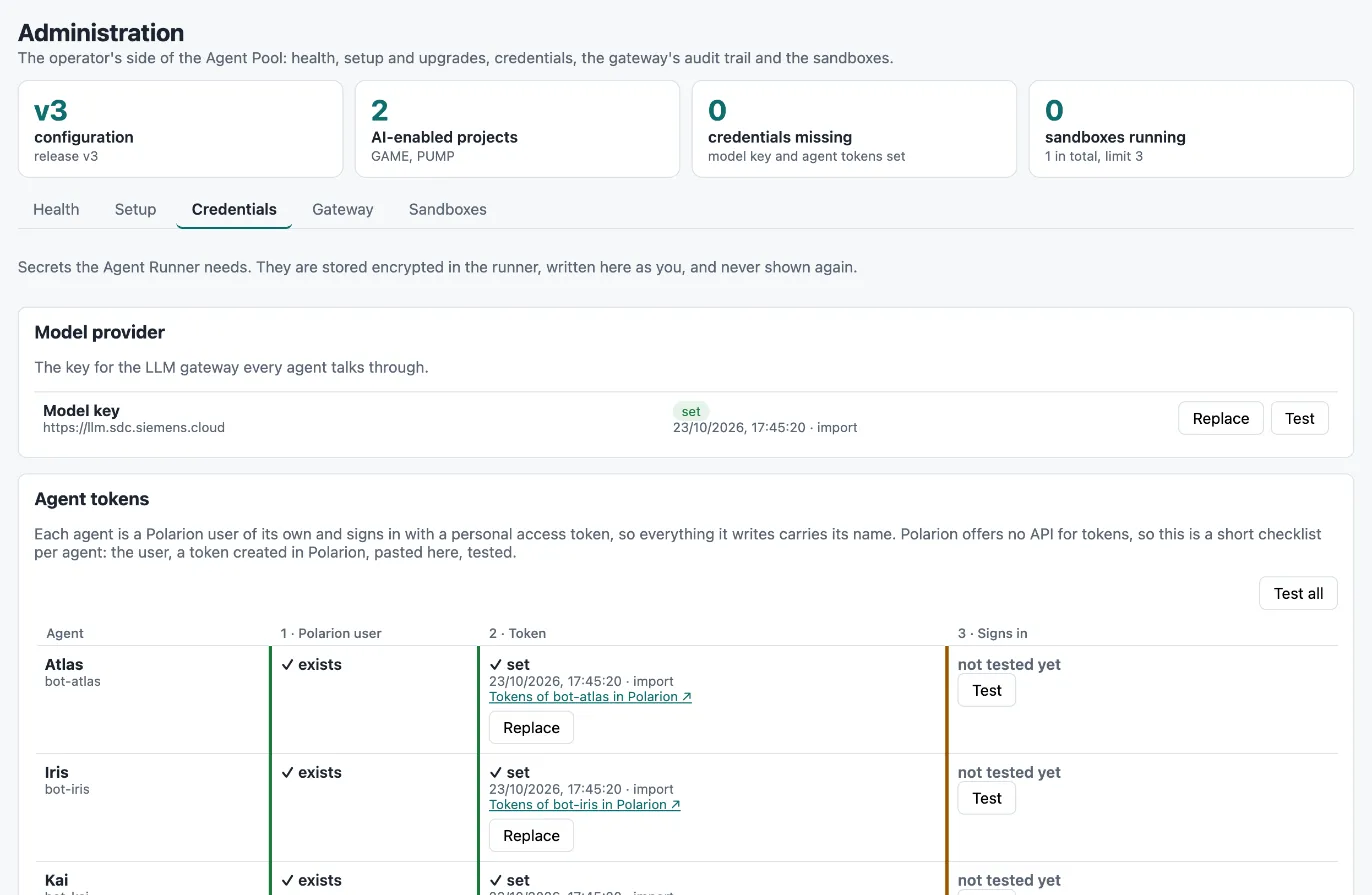
| Group | Items | Test |
|---|---|---|
| Model provider | The model key: the key for the LLM gateway every agent talks through. | Sends a one-token request through the gateway. |
| Agent tokens | A checklist per agent: 1 · its Polarion user exists (with a Create user button when not), 2 · a personal access token is set (with the link to the token page in Polarion), 3 · the token signs in. The list is derived from the agents in the pool: a new agent shows the open steps until the token is pasted and tested. Test all checks every agent at once. | Signs in to Polarion as that agent. |
| Connected systems | The credentials of MCP servers and git hosts, set when a connection is registered (see Connections). | Check server now on the connection. |
For each item:
- Set stores a value for the first time; Replace rotates it: paste the new value and agents use it on their next run, no restart needed. Then revoke the old value where it was issued.
- Test checks the stored value against the real system: the model key answers a one-token request, an agent token signs in as that agent.
- Every agent row links to the Polarion page where an administrator creates a personal access token for that
user (Create a token for
bot-…in Polarion ↗, later Tokens ofbot-…). Polarion offers no API for creating tokens, so this stays a copy-and-paste step; the licence of a new user is assigned in Polarion too.
Every write is made as the administrator who pastes the value and is recorded with their name and time, which is what the page shows next to set.
What is missing
Section titled “What is missing”Missing items are marked red on the page. The runner’s status (GET /status) and the
preflight check report them too: the Model gateway check fails without a
model key, and the Bot tokens check names every agent in the pool that has no token or whose token no longer
signs in. An agent without a token does not get work; a run that needs a missing credential ends with an error
that names the item.
Configuration that is not secret
Section titled “Configuration that is not secret”agentic.env (copy agentic.env.example from the repository) holds the plain configuration:
| Setting | Meaning |
|---|---|
POLARION_URL |
Polarion base URL, ending in /polarion. |
POLARION_VERIFY_TLS |
false only if Polarion uses a certificate the runner can’t verify. |
CORS_ORIGINS |
JSON list of browser origins allowed to call the runner (the Polarion server). |
POCKETBASE_ADMIN_EMAIL |
PocketBase superuser email; the password is the secret file. |
LLM_GATEWAY_URL |
Base URL of your model provider or company LLM gateway; the key is set in Administration → Credentials. |
MODEL_OVERRIDE |
Testing only: run every agent on this model. |
SANDBOX_EDGE_HOST, SANDBOX_MAX, SANDBOX_* |
Sandbox settings, see Sandboxes; the API key is the secret file. |
See Installation for the full list.